Precision Over Probability: The Weather Intelligence Professionals Turning Forecast Data Into Field Decisions

Photo: Credit: U. S. Weather Bureau, Public domain, via Wikimedia Commons
When the Forecast Gets It Wrong, the Field Pays
There is a particular kind of frustration familiar to anyone who has ever mobilized a crew based on a weather forecast that did not hold. Equipment is staged, personnel are on the clock, and then the sky delivers something the app on a supervisor's phone never anticipated. The cost of that mismatch—in idle labor, delayed schedules, and sometimes damaged machinery—is rarely captured in a single line item. It accumulates quietly, shift by shift, season by season.
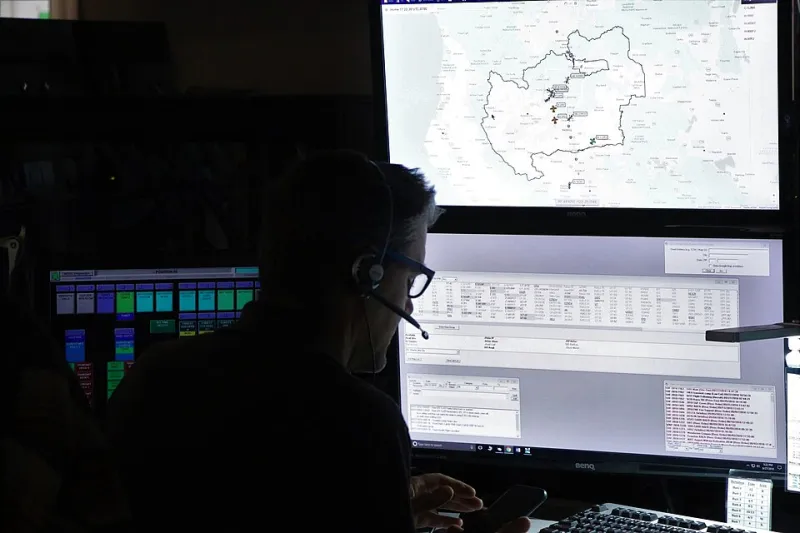
For years, field operations teams accepted weather variability as an unavoidable cost of doing business. That assumption is changing. Across the construction, logistics, utility, and infrastructure sectors, a specialized discipline has taken root: operational meteorology applied directly to ground-level work. The professionals practicing it are not simply reading the same National Weather Service data available to anyone with a smartphone. They are synthesizing localized models, historical site patterns, radar trends, and real-time sensor feeds to generate field-specific guidance that generic platforms are structurally incapable of providing.
The Limits of Consumer-Grade Forecasting
Consumer weather applications are engineered for broad audiences. They answer a simple question—should I bring an umbrella?—with reasonable accuracy across wide geographic areas. They are not designed to answer the questions that determine whether a $2 million crane lift proceeds or stands down, whether a freshly poured concrete slab will cure properly overnight, or whether road surface temperatures will create black ice conditions on a delivery route through the Appalachian foothills at 3 a.m.
The granularity gap matters enormously in field operations. A reported forecast for a metropolitan area may reflect conditions at an airport weather station ten miles from an active job site. Elevation changes, proximity to large water bodies, urban heat effects, and local topography can produce microclimatic conditions that diverge significantly from regional models. An operational meteorologist working with a specific client understands those local variables and builds them into every advisory.
Beyond geography, timing precision is equally critical. Knowing that rain is likely on a given afternoon is useful for a commuter. Knowing that precipitation is expected to taper before 6 a.m. and that wind speeds will fall below safe crane-operation thresholds by 9 a.m.—with high confidence—is the difference between a productive day and a wasted mobilization.
Embedding Intelligence Into the Operational Cycle
The most effective weather intelligence partnerships are not transactional. They are integrated into the operational planning cycle from the outset. Firms working with dedicated meteorological analysts typically establish a communication cadence tied to their scheduling windows—daily briefings during active projects, escalating alerts as significant weather approaches, and post-event debriefs that feed into future planning.
In the construction sector, this integration has measurable consequences. Concrete placement, roofing, steel erection, and earthmoving all carry specific atmospheric tolerances. A project superintendent who receives a site-specific forecast window—rather than a regional probability percentage—can sequence work phases with far greater confidence. Subcontractors can be dispatched or held with appropriate lead time rather than making game-day decisions that cascade into schedule disruptions.
For logistics and fleet operations, the stakes are different but no less significant. A regional carrier managing overnight freight across the upper Midwest during winter months faces a continuous set of weather-dependent decisions: route selection, departure timing, driver assignments, and load sequencing. Operational meteorologists embedded with such firms track developing storm systems days in advance, model their likely track with greater precision than public services, and generate actionable route advisories that reduce both accident exposure and delivery failures.
The Human Element in Weather Intelligence
What separates a skilled operational meteorologist from a sophisticated data feed is interpretive judgment. Weather modeling produces probabilistic outputs—ranges of possibility, not certainties. Translating those probabilities into specific operational recommendations requires an understanding of what the client does, how their equipment behaves under various conditions, and what the cost asymmetry looks like between acting on a forecast that proves wrong versus ignoring one that proves correct.
Experienced weather intelligence professionals develop that understanding through sustained engagement with their clients' operations. They learn that a particular earthmoving contractor can tolerate light rain on compacted fill but cannot risk it on exposed subgrade. They understand that a specific fleet's tire specifications change its safe operating threshold on icy roads. That contextual knowledge is not embedded in any algorithm. It is earned through repeated cycles of forecast, field outcome, and feedback.
This human dimension also extends to communication. A technically precise forecast delivered in meteorological terminology is of limited value to a field supervisor managing a crew in real time. The professionals who serve operational clients have learned to translate atmospheric science into the language of the job site—clear, actionable, and calibrated to the decisions that actually need to be made.
Quantifying the Return
Skepticism about the cost of dedicated weather intelligence services is understandable. For many smaller operations, the expense appears discretionary. The return, however, is not difficult to calculate once the true cost of weather-related disruption is examined honestly.
Equipment damage from unanticipated weather events—wind-toppled staging, freeze-damaged hydraulic systems, flooded material storage—represents direct losses that often dwarf the annual cost of a meteorological advisory service. Schedule overruns triggered by weather that could have been anticipated carry their own financial weight: extended equipment rentals, overtime labor, liquidated damages in contract-bound projects, and customer relationship costs that rarely appear on a balance sheet.
Safety incidents attributable to weather conditions carry consequences that are not reducible to dollars at all. The utility industry has long understood this, investing heavily in weather intelligence to protect line crews working in conditions that demand precise atmospheric awareness. That discipline is spreading into adjacent sectors as operational leaders recognize that the question is not whether they can afford weather intelligence—it is whether they can afford the alternative.
Ground Truth in an Uncertain Atmosphere
The atmosphere will always retain an element of irreducible uncertainty. No forecast, however precise, eliminates the possibility of unexpected conditions. What operational meteorology does is compress the range of that uncertainty to a level where informed decisions become possible—where field teams are not gambling, but calculating.
For operations running on tight margins, compressed timelines, and the expectation that crews will perform safely and productively regardless of what the sky produces, that compression is not a luxury. It is a competitive advantage built into the planning process before the first piece of equipment ever leaves the yard.