Below the Waterline: The Commercial Divers Certifying Every Drop From America's Municipal Tanks
Below the Waterline: The Commercial Divers Certifying Every Drop From America's Municipal Tanks
There is a particular kind of professional invisibility that comes not from obscurity but from success. When a system works perfectly, no one asks how. Municipal water storage is exactly that kind of system. Across the United States, hundreds of thousands of water storage tanks — ground-level reservoirs, elevated standpipes, buried concrete cisterns — quietly maintain pressure and supply for cities, suburbs, and rural communities alike. They are inspected on a rotating schedule, cleaned when sediment accumulates, and certified to meet state and federal drinking water standards. Most residents will never know any of this is happening. The people making it happen prefer it that way.
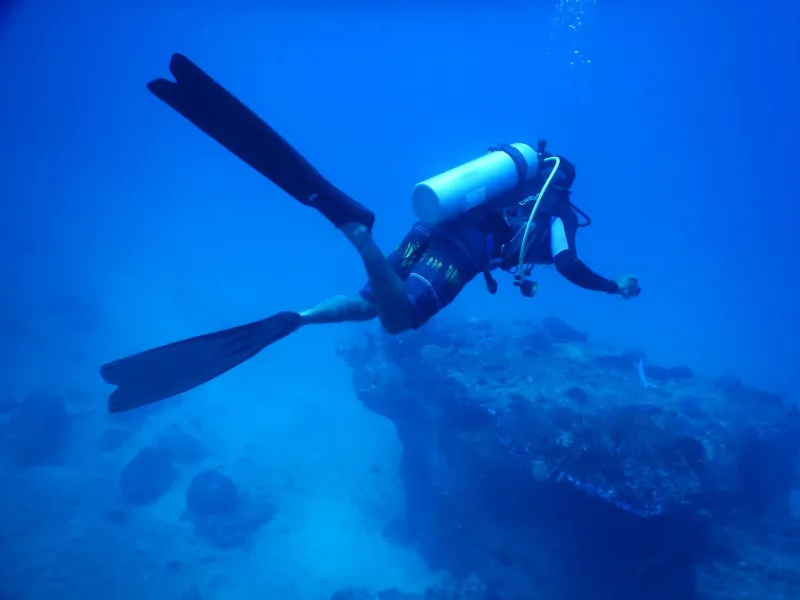
They are commercial divers who specialize in potable water systems, and their work sits at the intersection of underwater construction, public health compliance, and operational precision. It is a niche that demands technical rigor, physical endurance, and an unusual tolerance for working in conditions that are, by most definitions, genuinely hostile.
Into the Dark
The defining characteristic of a potable water tank dive is visibility — or the near-total absence of it. Unlike coastal or river diving, where ambient light and current create at least some spatial orientation, the interior of a municipal storage tank is a closed, lightless environment. The water itself is typically treated, which means it carries residual chlorine. Sediment disturbed from the tank floor rises almost immediately in still water, reducing visibility to inches or eliminating it entirely within the first few minutes of a dive.
Divers navigate these environments using physical contact — running gloved hands along curved concrete walls, locating inlet and outlet pipes by feel, mapping cracks or corrosion by touch before a camera can document them. Many teams use remotely operated vehicles (ROVs) for initial surveys, but ROVs have limitations in confined spaces and cannot perform hands-on cleaning or structural assessment with the precision a trained diver can provide.
The work requires a specific mental composure. Disorientation in a sealed tank with no visible surface reference is a genuine occupational hazard. Training programs that prepare divers for this environment emphasize not just technical skills but the psychological discipline to work methodically when instinct might push toward panic.
The Certification Landscape
Potable water diving operates within a framework of overlapping regulatory requirements. At the federal level, the Environmental Protection Agency and the Safe Drinking Water Act establish baseline standards for water system integrity. At the state level, departments of environmental quality or public health typically govern inspection frequency and documentation requirements. Many states mandate that inspections occur every three to five years, though some jurisdictions require annual review for larger systems.
The divers themselves must hold commercial diving certifications — most commonly through the Association of Diving Contractors International (ADCI), the industry's primary professional body. Beyond that baseline, potable water work frequently requires additional training in confined space entry, hazardous materials handling, and disinfection protocols. Before entering any tank, divers typically undergo a decontamination and suit-up process designed to prevent the introduction of any contaminants into the water supply. After the dive, equipment is disinfected before removal from the site.
Some states require that the diving contractor coordinate directly with the relevant health authority and submit inspection reports through official channels. The documentation produced from a single tank dive — photographs, video footage, structural condition ratings, sediment volume estimates — can run to dozens of pages and serves as the formal record of compliance for a municipality's water system audit.
Live-Water Operations
One of the most consequential aspects of potable water tank inspection is that it typically occurs while the tank remains in service. Shutting down a storage tank for inspection means removing it from the distribution system, which can affect pressure, reduce emergency fire suppression capacity, and require complex hydraulic management across the broader water network. For most municipalities, that disruption is impractical.
Live-water diving resolves that operational problem, but it introduces its own complexity. The diver is working inside an active component of a pressurized water distribution system. Inlet flows must be carefully managed. The diving team maintains constant communication with the water utility's operations staff, who monitor system pressure and can isolate the tank if an emergency requires it. Every entry is a coordinated event, not a solo operation.
This coordination dynamic is part of what makes experienced potable water diving teams valuable beyond their underwater skills. The best contractors in this space understand water system hydraulics, speak the operational language of utility engineers, and can translate their findings into actionable maintenance recommendations. They function as field partners to the municipalities they serve, not simply as vendors executing a task.
What the Inspections Find
The condition of America's water storage infrastructure is, by most assessments, a mixed picture. The American Society of Civil Engineers has repeatedly flagged drinking water infrastructure as a category requiring urgent investment, and the tanks themselves reflect that broader reality. Divers routinely document sediment accumulation that has gone unaddressed for years, sometimes decades. Coating failures — where protective epoxy or paint has delaminated from tank walls — expose bare steel or concrete to corrosive water chemistry. Structural cracks, inlet pipe corrosion, and compromised cathodic protection systems are common findings.
None of these conditions are automatically catastrophic, but each represents a degradation of a system that carries drinking water to homes, hospitals, schools, and businesses. Left unaddressed, coating failures accelerate structural deterioration. Sediment accumulation can harbor bacteria and compromise disinfection effectiveness. A crack that is manageable today becomes a major repair — or a failure — if it goes undetected.
The inspection report is, in this sense, a form of institutional memory. It tells a municipality not just what is wrong today but what has changed since the last inspection, providing the longitudinal data that responsible infrastructure management requires.
The Workforce Behind the Work
The pool of commercial divers qualified for potable water work is relatively small, and the number who specialize in it as a primary focus is smaller still. Training pipelines for commercial diving — through institutions like the Commercial Diver Training Center in Florida or Divers Institute of Technology in Seattle — produce graduates who then spend years developing the specific competencies that municipal water work demands. It is not a career one enters quickly.
Retention is a persistent challenge. The physical demands of the work, the irregular project schedules driven by municipal procurement cycles, and the geographic mobility required to service clients across wide regions all create friction. Experienced divers are a genuine operational asset, and the contractors who build stable, well-trained teams tend to hold them carefully.
For the municipalities on the other side of the contract, that expertise is not optional. Water quality is not a domain where approximation is acceptable. The divers who descend into those tanks are the last human checkpoint between an aging storage system and the public that depends on it.
They surface, decontaminate, file their reports, and move on to the next tank. The water keeps flowing. No one notices. That is, by every measure, exactly how it should be.