Hands on Steel: The Unsung Inspection Crews Keeping America's Bridges From Falling
Hands on Steel: The Unsung Inspection Crews Keeping America's Bridges From Falling
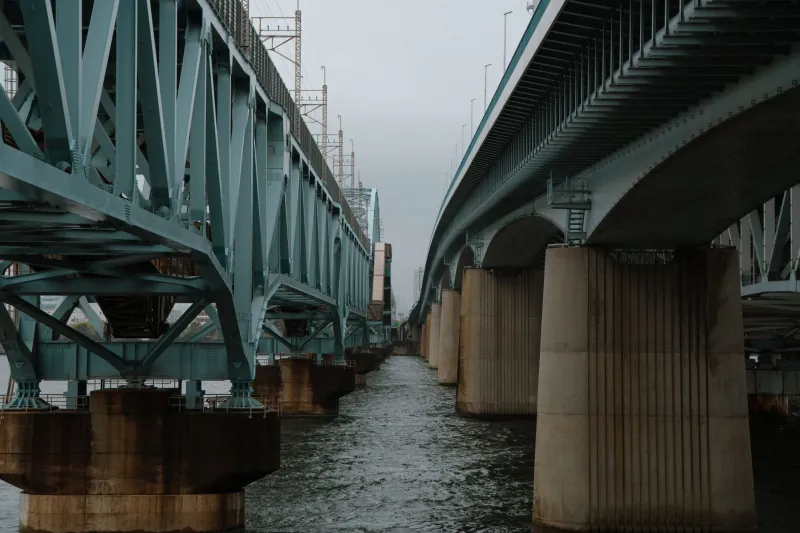
Every morning, somewhere in America, a small crew pulls a truck onto the shoulder of a bridge carrying tens of thousands of vehicles per day. They unload snooper trucks, harnesses, and underwater cameras. They clip on safety lanyards and descend into spaces most commuters never think about — the undersides of deck spans, the interior chambers of box girders, the scoured gravel beds around concrete footings that have been quietly shifting for decades. By the time rush hour ends, they will have seen things no software model has ever rendered.
These are the nation's bridge inspection crews. They are certified, methodical, and almost entirely invisible to the public they protect.
A System Built on Human Eyes
The Federal Highway Administration requires that all public highway bridges be inspected at least once every twenty-four months. That mandate covers more than 620,000 bridges across the country — a number so large it can obscure the sheer physical difficulty of what inspection actually involves. Bridges are not flat surfaces. They are three-dimensional structures exposed to freeze-thaw cycles, saltwater corrosion, heavy dynamic loading, and, in many cases, decades of deferred maintenance.
Meeting that inspection standard is not a desk job. It requires crews who can read a crack pattern in concrete and distinguish between cosmetic surface weathering and a fracture propagating toward a load-bearing element. It requires someone who knows what a section loss in a steel girder looks like when it is obscured by rust staining, bird nests, and a century of grime. That kind of judgment is not produced by a software dashboard. It is earned through years of fieldwork.
The training pipeline for bridge inspectors is rigorous by any standard. The FHWA's National Bridge Inspection Standards require that team leaders hold a Professional Engineer license or demonstrate equivalent experience under direct supervision. Many inspectors hold certifications through the National Institute for Certification in Engineering Technologies. Still, the credential only gets them to the job site. What they do once they are there depends entirely on what they have learned to see.
What the Models Miss
Structural modeling has improved dramatically over the past two decades. Finite element analysis, drone-mounted LiDAR scanning, and acoustic emission sensors have all expanded the toolkit available to bridge engineers. These technologies are genuinely useful. They can identify geometric deformations, flag thermal anomalies, and generate three-dimensional records of a structure's current condition.
But the field crews will tell you what the models miss.
They miss the sound a hollow section makes when you tap it with a hammer. They miss the faint sheen of moisture weeping through a hairline crack that does not yet register on any sensor. They miss the way a bearing pad has shifted imperceptibly out of alignment — not enough to trigger an automated alert, but enough to tell an experienced inspector that load transfer is no longer happening as designed. They miss the smell of a timber pile that has been slowly rotting from the inside out.
Sensors measure. Inspectors interpret. The distinction matters enormously when the structure in question carries a school bus route or a freight rail corridor.
The Rappel, the Wade, and the Crawl
Physical access is one of the least-discussed dimensions of bridge inspection, and one of the most demanding. Depending on the structure, an inspection crew might spend a day suspended in a snooper truck beneath a major interstate overpass, navigating a work platform through a forest of girders while traffic thunders overhead. On a rural timber trestle, they might wade through chest-deep water to probe the condition of submerged piles by hand. On a long-span suspension bridge, they might rappel from the main cable to access the suspender ropes.
None of this is incidental. Access is where the work happens. A remote-sensing technology that cannot physically reach a deteriorating element cannot assess it. The crew that can get there — safely, efficiently, and with the trained judgment to know what they are looking at — is the irreplaceable variable in the inspection equation.
In recent years, rope access techniques borrowed from the industrial inspection sector have become more common on complex bridge structures. Crews trained in rope access can reach locations that neither snooper trucks nor drones can effectively evaluate. This expansion of physical access capability represents one of the most meaningful advances in practical bridge inspection — not because it is high-tech, but because it puts skilled human observers exactly where the structure's most vulnerable elements are.
The Infrastructure Funding Surge and the Workforce Gap
The Infrastructure Investment and Jobs Act, signed into law in 2021, directed more than $110 billion toward roads and bridges. A significant portion of that funding is flowing toward bridge rehabilitation and replacement projects across the country. That is welcome news for a national bridge inventory in which roughly forty thousand structures are currently rated in poor condition.
The less welcome news is that the inspection workforce required to support that investment surge is not keeping pace.
Experienced bridge inspectors are retiring faster than new ones are being trained and certified. The pipeline of qualified team leaders is particularly thin. Building that expertise takes time — not just classroom hours, but seasons of fieldwork on different structure types, in different environments, across different failure modes. A newly certified inspector has the foundation. The judgment comes later, and it cannot be accelerated by budget allocation alone.
This gap has real operational consequences. Inspection cycles can stretch. Documentation quality can vary. The subtle findings that an experienced crew would flag — the ones that do not yet meet a formal threshold for action but warrant monitoring — may go unrecorded when workloads are too high and qualified personnel are too few.
Recognition as a Resource Problem
There is a persistent tendency in infrastructure discussions to focus on materials and money — how many bridges will be replaced, how much concrete will be poured, how many miles of deck will be resurfaced. These are legitimate metrics. But they describe outputs, not the process that determines whether those outputs are targeted correctly.
The inspection crews are the process. They are the mechanism by which the condition of the national bridge inventory is actually known, not estimated, not modeled, but known — from direct physical observation, by people who have spent careers learning what deterioration looks like in its early stages, when intervention is still affordable.
Investing in that workforce — in training pipelines, in competitive compensation, in the tools and access equipment that let inspectors do their jobs safely and thoroughly — is not a secondary consideration. It is a prerequisite for everything else the infrastructure funding surge is supposed to accomplish.
The bridge that does not collapse is the bridge where someone crawled into a dark corner, tapped a steel plate, heard something they did not like, and wrote it down. That person deserves to be part of the conversation about how America rebuilds.
Right now, they are mostly under the bridge while the conversation happens without them.