The Art of the Walk-Through: How Operations Observers Are Solving Fulfillment Center Problems That Software Cannot Find
The warehouse management system said throughput was within acceptable parameters. The labor productivity reports showed nothing unusual. The pick accuracy metrics were green across the board.
And yet, every afternoon between two and four o'clock, orders were backing up at the pack stations, pickers were wandering, and the shipping dock was falling behind. Nobody could explain it. The software certainly could not.
So the facility manager did something that felt almost anachronistic in an era of sensor arrays and algorithmic optimization. He called in someone to watch.
Observation as a Professional Discipline
The role goes by several names. Operations observer. Warehouse flow consultant. Facility efficiency analyst. In practice, the title matters less than the methodology, which is deceptively simple: spend extended time on the floor of a fulfillment center or logistics facility, watching actual work happen, and document what you see.
No simulation. No time-motion study conducted over a single shift. No survey distributed to floor supervisors. Just sustained, informed observation of the operation as it actually functions — including the informal workarounds, the communication gaps, the traffic patterns that emerge organically among workers who have developed their own logic for navigating a space.
The practitioners who do this work well bring a specific combination of qualifications. Most have direct experience in warehouse or distribution operations — they have worked the floor, managed picking teams, run shifts. That background gives them a frame of reference for what they are observing. They know the difference between a worker who is inefficient and a worker who has adapted to an inefficient system. They know what a traffic bottleneck looks like before it fully develops. They know which questions to ask and, more importantly, which workers to ask them of.
What Algorithms Miss
Warehousing has invested heavily in technology over the past decade. Warehouse management systems, labor management systems, automated guided vehicles, pick-to-light arrays, RFID tracking, computer vision — the list of available tools is long and growing. Each of these technologies generates data. Much of that data is genuinely useful.
But data is a record of what happened. It is not always a reliable guide to why it happened, and it is rarely sufficient on its own to identify what should change.
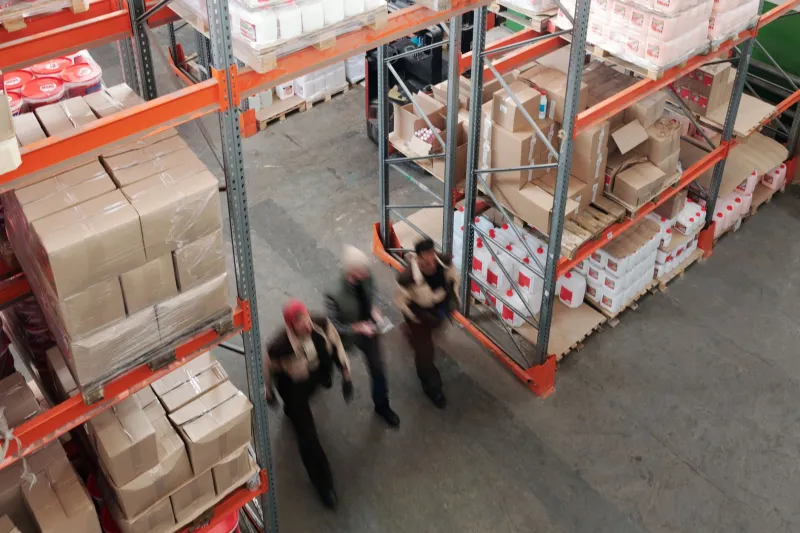
Consider the afternoon backup described above. An observer spending three consecutive afternoons on that facility's floor identified the root cause within the first day: a single pack station positioned at the intersection of two primary travel lanes was creating a micro-congestion point that cascaded through the entire outbound process. Pickers approaching from the east aisle were merging with cart traffic from the receiving area at exactly the moment when pack station activity peaked. The resulting hesitation — a matter of seconds per interaction — compounded across dozens of workers over two hours into a measurable throughput loss.
The fix was a minor lane reconfiguration and a staggered scheduling adjustment for one receiving team. Implementation cost: negligible. The WMS had been generating throughput data for eighteen months without surfacing the issue, because the data captured the output without capturing the physical reality that was constraining it.
The Informal Architecture of Work
One of the most consistent findings that experienced operations observers report is the gap between the designed workflow and the actual workflow. Workers in high-volume fulfillment environments are relentlessly pragmatic. When the official process is inefficient, they adapt. They find shortcuts. They develop informal staging areas. They establish unwritten conventions for navigating congested zones.
Some of these adaptations are genuinely clever — the kind of ground-level innovation that deserves to be formalized and adopted facility-wide. Others introduce safety risks or create new inefficiencies downstream that are not visible from the point where the adaptation occurs.
An operations observer who spends enough time on the floor learns to read this informal architecture. They can identify which worker-generated conventions are worth preserving and which ones are quietly undermining the operation. They can trace the logic of a workaround back to the original friction point that created it — which is frequently the actual problem that needs to be solved.
This kind of insight does not appear in a productivity dashboard. It requires presence.
Talking to the People Who Know
A dimension of operations observation that distinguishes it from purely quantitative analysis is the reliance on worker knowledge. The people who perform repetitive tasks in a fulfillment environment develop a detailed, granular understanding of how that environment functions. They know which pick locations are consistently mislabeled. They know which aisles become impassable during certain shift transitions. They know which processes make no practical sense.
This knowledge is rarely solicited through formal channels. Annual surveys and supervisor feedback loops tend to surface only the most visible, most frequently complained-about issues. The subtler friction points — the ones that cost thirty seconds per cycle across hundreds of cycles per shift — go unreported because no single instance feels significant enough to raise.
Effective operations observers create informal conditions for this knowledge to surface. A conversation at a pack station during a natural lull. A question asked of a picker at the end of a zone. The answers, accumulated over multiple shifts and multiple conversations, frequently reveal patterns that no formal data collection process would have captured.
The Case Against Pure Automation Dependency
None of this is an argument against technology. Automated systems have genuinely transformed fulfillment operations, and the capabilities of warehouse technology will continue to expand. The argument, rather, is against the assumption that technology is a complete substitute for informed human observation.
Fulfillment centers are physical environments inhabited by human beings. They have spatial characteristics that simulations approximate but do not fully replicate. They have social dynamics — informal hierarchies, communication patterns, morale conditions — that affect operational performance in ways that are real but difficult to quantify. They have emergent behaviors that arise from the interaction of dozens or hundreds of people navigating a shared space under time pressure.
These realities respond to human observation in ways they do not respond to data collection alone. The operations observer who walks the floor, watches the work, and listens to the workers is gathering a category of information that complements rather than competes with quantitative analysis.
The best outcomes in fulfillment center optimization tend to combine both. The data identifies that a problem exists and roughly where it is located. The observer goes to that location, watches what actually happens, and determines what is causing it.
Ground-Level Intelligence in a Data-Saturated Industry
The facilities that are getting this right are the ones that have resisted the temptation to treat operations improvement as a purely analytical exercise. They recognize that the floor holds information that the system does not — and that accessing that information requires someone willing to stand in it, walk through it, and stay long enough to see what it is actually showing.
In an industry that has invested billions in automation and analytics, the walk-through remains one of the most reliable diagnostic tools available. The people who have mastered it are not working against technology. They are filling the gap that technology, for all its sophistication, has not yet closed.