The First Breath of Warning: Environmental Field Samplers and the Data That Keeps American Workers Alive
The air at a demolition site looks clean. That is part of what makes it dangerous.
Lead dust from decades-old paint. Asbestos fibers released from disturbed pipe insulation. Silica particles generated by concrete cutting. Benzene vapors drifting from soil disturbed during excavation. None of these hazards are visible to the human eye. None of them produce immediate symptoms. All of them are capable of causing serious, irreversible harm — and all of them are routinely present at active industrial and construction sites across the United States.
The professionals tasked with detecting these hazards before they reach workers operate largely outside public view. They are environmental field samplers: technicians trained in air monitoring, soil sampling, hazardous material identification, and the regulatory frameworks that govern all of the above. Their work is unglamorous, technically demanding, and consequential in ways that are difficult to overstate.
What the Work Actually Looks Like
A typical engagement for an environmental sampling team begins well before any construction or demolition activity starts. The technicians review site history, previous environmental assessments, and any known contamination records. They identify the materials likely to be disturbed and the exposure pathways most likely to affect workers.
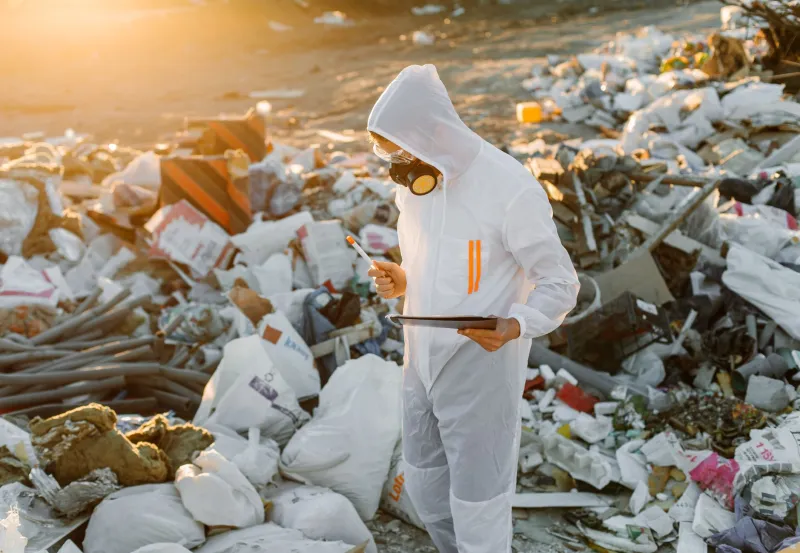
On site, they deploy a range of collection equipment. Personal air monitors are placed on individual workers to measure real-time exposure at the breathing zone — the most accurate measure of what a person actually inhales during a shift. Area monitors are positioned at perimeter boundaries to assess off-site migration of contaminants. Soil samples are collected from designated grid points and submitted to certified laboratories for analysis.
The data generated by this process is not simply filed and forgotten. It drives operational decisions in real time. If a personal monitor registers silica concentrations above permissible exposure limits, work stops and respiratory protection protocols are escalated. If perimeter air samples indicate that particulates are migrating toward adjacent properties, dust suppression measures are activated or demolition activities are suspended.
The sampling technician is, in this sense, a continuous feedback loop embedded within the operation itself.
Regulatory Stakes and Operational Reality
The Occupational Safety and Health Administration and the Environmental Protection Agency together establish the regulatory framework within which environmental samplers operate. OSHA's permissible exposure limits define the maximum concentrations of specific substances workers may be exposed to over an eight-hour shift. EPA regulations govern site cleanup standards and off-site contamination thresholds.
Violations of these standards carry significant consequences. OSHA citations can reach into the tens of thousands of dollars per violation. EPA enforcement actions can result in project shutdowns, mandatory remediation, and civil penalties that run into the millions. For a contractor operating on thin margins — which describes most of the industry — a single enforcement action can be operationally devastating.
Environmental samplers are, among other things, the mechanism by which contractors demonstrate compliance. Their monitoring records constitute the documented evidence that due diligence was exercised. In the event of a worker illness claim or a regulatory investigation, those records are often the difference between a defensible position and an indefensible one.
But framing the value of environmental sampling purely in terms of regulatory compliance misses the more fundamental point. These technicians protect people. The data they collect determines whether the men and women on a job site are being exposed to substances that will affect their health years or decades from now.
The Asbestos Problem That Will Not Go Away
Of all the hazards that environmental samplers encounter, asbestos remains among the most persistent and the most serious. Despite being largely banned from new construction materials in the United States since the late 1970s, asbestos-containing materials remain present in an enormous portion of the existing building stock.
Buildings constructed before 1980 — schools, hospitals, office towers, industrial facilities, apartment complexes — frequently contain asbestos in floor tiles, ceiling tiles, pipe insulation, roofing materials, and fireproofing compounds. When these buildings are renovated or demolished, those materials must be identified, tested, and managed according to strict regulatory protocols.
The identification process falls to environmental samplers. Bulk samples of suspect materials are collected, handled under controlled conditions, and submitted for laboratory analysis. A positive finding triggers a regulated abatement process before demolition can proceed. A missed finding — or a finding that is deliberately ignored — puts every worker on the site at risk.
The stakes are not abstract. Mesothelioma, the cancer most closely associated with asbestos exposure, has a latency period of twenty to fifty years. Workers exposed today may not receive a diagnosis for decades. By the time the illness manifests, establishing causation is difficult and accountability is elusive.
Environmental samplers are one of the few operational mechanisms capable of interrupting this chain of events before it begins.
Beyond the Construction Site
The environmental sampling profession extends well beyond demolition and renovation work. Industrial manufacturing facilities require ongoing air quality monitoring to ensure that emissions from production processes remain within permitted limits. Agricultural operations in some regions are subject to soil contamination monitoring related to pesticide application. Superfund sites and brownfield redevelopment projects require extensive sampling programs that can span years.
In each context, the field technician is performing essentially the same function: collecting physical evidence from the environment and translating it into data that informs decisions. The settings differ. The specific hazards differ. The core discipline — rigorous, methodical, field-level data collection — remains constant.
A Profession Built on Precision Under Pressure
What distinguishes effective environmental samplers from adequate ones is not primarily technical knowledge, though that knowledge is essential. It is the capacity to maintain procedural discipline under conditions that actively work against it.
Field sampling is conducted in environments that are noisy, physically demanding, and frequently chaotic. Equipment must be calibrated correctly and operated correctly. Sample collection procedures must be followed precisely to ensure that laboratory results are defensible. Chain-of-custody documentation must be completed accurately and completely.
These requirements do not become easier when the temperature is ninety-five degrees, when the crew is behind schedule, and when a project manager is asking when the sampling will be done. The technician's ability to hold the line on procedural integrity under those conditions is what makes the data meaningful.
It is also, not coincidentally, what makes the profession genuinely difficult to do well.
The canary in the coal mine is a metaphor that has outlasted the practice it describes. Modern mines have instruments. Modern industrial sites have environmental samplers — professionals who read what the air is saying and report back before the damage is done. The work is unglamorous. The consequences of getting it wrong are not.