Sky Readers: The Field Crews Who Trust Their Eyes More Than the Forecast
The morning briefing at a utility line crew staging area in western Kansas had called for a dry workday with winds under fifteen miles per hour. By 9:40 a.m., the crew foreman had already ordered equipment secured and personnel moved to vehicles. The clouds building on the southwestern horizon had a particular structure — anvil-topped, with a greenish cast at the base — that he recognized without needing to consult a radar application. The National Weather Service issued a severe thunderstorm warning for the county forty-seven minutes later.
No one on the crew was surprised. They had watched the same sky.
When the Forecast and the Sky Disagree
Weather forecasting has improved dramatically over the past two decades. Numerical modeling, high-resolution satellite imagery, and real-time Doppler radar have given meteorologists tools that produce genuinely useful predictions for most conditions in most locations. For the average person planning a weekend activity, a modern forecast application is reliable enough to be decisive.
For field professionals operating in high-consequence environments, the calculus is different. A forecast is a probabilistic statement about conditions across a geographic area over a defined time window. The crew working a specific job site at a specific moment needs information about conditions at that location, at that time, with enough lead time to make decisions that protect people and equipment. Those two things — forecast and operational reality — frequently diverge in ways that matter enormously.
The divergence is most pronounced in transition weather: the conditions that exist between stable atmospheric states, when local topography, surface heating, or moisture convergence can produce rapid development that regional models underestimate. It is precisely in these transitions that experienced field professionals most consistently outperform the apps on their phones.
What Experienced Field Workers Actually Read
The observational vocabulary that outdoor field professionals develop over years of exposure is specific and functional. It is not mysticism. It is applied meteorology, learned empirically rather than academically, calibrated against thousands of hours of direct observation.
Cloud structure is primary. The vertical development of cumulus clouds — the rate at which flat-bottomed fair-weather clouds begin to build upward into towering formations — is one of the most reliable visible indicators of atmospheric instability. Field workers who have spent years outdoors develop a sense of what rate of development is normal for a given time of day and season, and what rate suggests something more significant is organizing overhead.
Wind behavior provides a second layer of information. A shift in wind direction, particularly a backing wind — one that rotates counterclockwise — can indicate an approaching low-pressure system or the outflow boundary from a distant storm. Experienced crews notice these shifts not by checking an anemometer but by feeling the change in air movement against their skin and observing how it affects dust, vegetation, and loose materials on the job site.
Atmospheric pressure, while not directly observable without instruments, communicates itself through physical sensation. Many veteran field workers describe the sensation of falling pressure — the subtle heaviness in the air, the way sounds carry differently, the behavior of insects and birds — as a reliable precursor to significant weather. These are not superstitions. They reflect genuine physiological and environmental responses to barometric change that human beings can perceive with some consistency after sufficient exposure.
Decision Frameworks Under Atmospheric Uncertainty
The most operationally sophisticated outdoor crews in the United States have developed explicit frameworks for weather-related decisions — protocols that specify what observable conditions trigger what responses, independent of what any forecast application displays.
Commercial roofing operations, which are among the most weather-sensitive field activities in the construction industry, often operate on a tiered response model. Certain visible or perceptible conditions — lightning within a defined distance, wind speeds that compromise material handling, visible rotation in cloud bases — trigger mandatory work stoppage regardless of forecast conditions. Other indicators initiate a heightened monitoring posture: crews continue working but equipment is staged for rapid securing, and designated observers maintain continuous sky watch.
Outdoor event production crews, who manage the intersection of large crowds, temporary structures, and weather uncertainty, operate under similar frameworks. The decision to strike a tent structure or activate an evacuation protocol cannot wait for a warning to appear on a phone screen. By the time an official alert is issued, the atmospheric conditions that necessitate action have often already developed to a point that compresses the available response window dangerously.
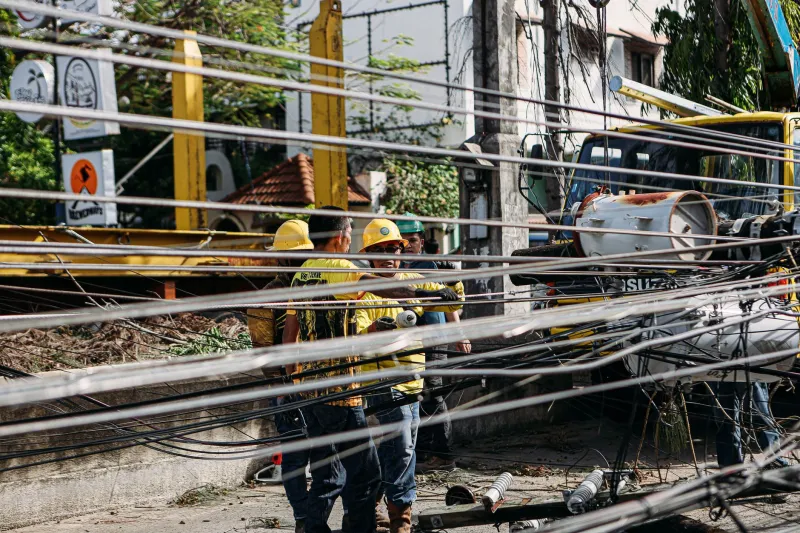
Utility restoration crews, who frequently work in post-storm environments where new weather systems can arrive before work is complete, develop protocols that account for the compounded risk of operating in already-compromised conditions. The threshold for pausing work is lower when the crew is already managing elevated hazard exposure.
The Institutional Challenge of Preserving This Knowledge
Like much field expertise, atmospheric reading is difficult to formalize and transfer. It is acquired through extended outdoor exposure across varied conditions — a process that cannot be meaningfully accelerated through classroom instruction or digital simulation. Senior field professionals who have developed reliable weather intuition often struggle to articulate the specific cues they are integrating, because the skill operates at a level of pattern recognition that precedes conscious analysis.
This creates a genuine organizational challenge as experienced field workers retire. The institutional knowledge that keeps crews safe in rapidly changing conditions is walking out the door at a rate that formal training programs are not currently equipped to replace. Some organizations are addressing this through extended mentorship rotations that pair newer field personnel with senior crew leaders across multiple seasons, specifically to develop the breadth of atmospheric exposure that builds reliable intuition.
Others are investing in structured observation logs — documentation that captures the specific conditions present when weather-related decisions were made, creating a reference library that newer personnel can study alongside their on-the-job experience. Neither approach is a substitute for time spent outdoors under varied conditions, but both acknowledge that this knowledge has organizational value worth preserving.
The Forecast Is a Starting Point
None of this is an argument against weather forecasting technology. The most effective outdoor field operations in the United States use both: current forecast data as a planning baseline, and continuous real-time observation as the operational layer that makes final decisions.
The forecast tells a crew what to expect. The experienced field professional's eyes, ears, and accumulated instinct tell that crew what is actually happening — and, critically, what is about to happen in the next twenty minutes, in the specific location where the work is being done.
In the gap between those two things, people either get home safely or they don't. The crews that close that gap most reliably are the ones who have learned to read the sky the way their predecessors did: directly, attentively, and with a respect for what the atmosphere can do when the models don't quite capture the moment. That skill is not a relic of a pre-digital era. It is a ground-level competency that no application update has yet made redundant.