Wired Into the Storm: The Line Workers Who Build America's Power Resilience One Pole at a Time
Wired Into the Storm: The Line Workers Who Build America's Power Resilience One Pole at a Time
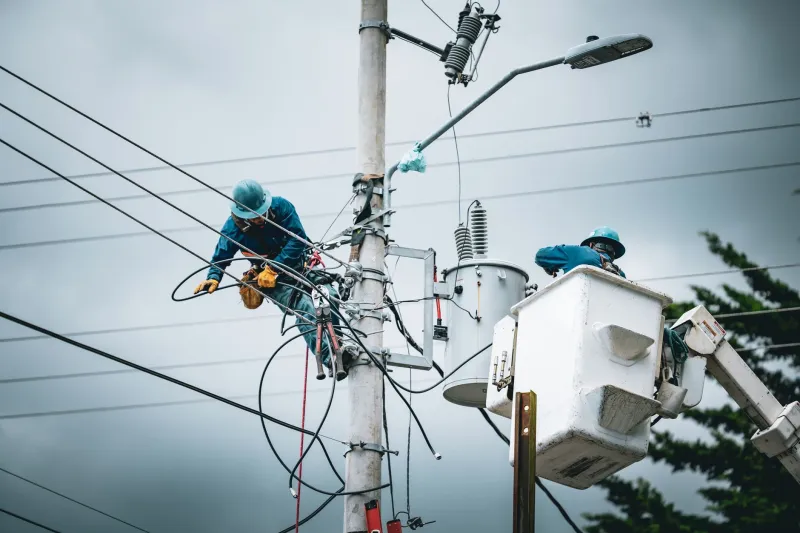
On a Tuesday morning in January, a line crew from a rural electric cooperative in western Kentucky was already suited up before sunrise. An ice storm had moved through overnight, and transmission lines along a forty-mile corridor were sagging under the weight of accumulated glaze. By the time most residents in the affected counties had poured their first cup of coffee, the crew was already on-site — assessing, coordinating, and preparing to work within feet of energized conductors carrying tens of thousands of volts.
There were no algorithms guiding their sequencing decisions. No remote dashboard flagged the precise location where a line had shifted dangerously close to a secondary conductor. That determination came from a foreman with nineteen years in the field, reading the tension in the wire the way a sailor reads wind in a sail.
This is how American power resilience actually works.
The Gap Between Policy and Pavement
The national conversation around energy infrastructure tends to concentrate on the macro: grid modernization legislation, renewable integration targets, cybersecurity frameworks, and long-range capital investment plans. These are legitimate and important discussions. But they share a common blind spot — they treat the physical grid as a managed abstraction rather than a living system that requires constant human attention at the ground level.
The United States operates one of the most complex electrical networks on earth, spanning approximately 6.3 million miles of transmission and distribution lines according to the U.S. Energy Information Administration. That network runs through mountains, deserts, floodplains, and dense urban corridors. It is exposed to hurricanes in the Gulf Coast, ice storms in the Midwest, wildfires in the West, and nor'easters along the Atlantic seaboard. Keeping that system operational is not primarily a software problem. It is a labor problem — one solved daily by roughly 120,000 line workers employed across investor-owned utilities, cooperatives, and municipal systems nationwide.
These workers are, in the most literal sense, the architects of whatever resilience the grid actually possesses.
What the Work Actually Demands
Utility line work is consistently ranked among the most physically hazardous occupations in the country. The Bureau of Labor Statistics places electrical power-line installers and repairers among the top ten most dangerous jobs in the United States by fatal injury rate. The risks are immediate and unforgiving — falls from heights, arc flash events, electrocution, and equipment failures under load.
But the hazard profile only tells part of the story. What the statistics cannot fully capture is the cognitive demand of the work.
A journeyman lineman operating on a distribution circuit must simultaneously manage the physical task at hand, maintain situational awareness of the energized environment around them, communicate clearly with a ground crew that may be twenty or thirty feet below, and anticipate how a repair decision in one section of the circuit will affect load conditions elsewhere on the line. This is not rote labor. It is applied systems thinking, executed under physical stress, often in adverse weather, with consequences measured in seconds.
The training pipeline reflects this complexity. A typical apprenticeship in the line trade runs four to five years, combining classroom instruction in electrical theory, equipment operation, and safety protocols with thousands of hours of supervised field work. Apprentices do not graduate to independent work until they have demonstrated competency across a defined range of tasks — a standard that exists precisely because the margin for error is so narrow.
Distributed Decision-Making at Scale
One of the least-discussed aspects of utility field operations is the degree to which critical decisions are made by distributed crews operating with significant autonomy. During a major storm restoration event — the kind that follows a Category 3 hurricane or a widespread ice storm — a large utility may have hundreds of crews deployed simultaneously across thousands of square miles. Centralized dispatch can coordinate logistics and set restoration priorities, but the actual sequencing of work at each site is determined by the crew on the ground.
That foreman in western Kentucky, reading the tension in an ice-laden conductor, is making a call that no control room operator can make remotely. The information required for that decision — the visual cues, the physical feedback, the accumulated pattern recognition built over nearly two decades of field experience — does not transmit through a fiber optic cable. It lives in the body and mind of someone standing at the base of a pole in sub-freezing temperatures.
This distributed model of expertise is not a legacy inefficiency waiting to be automated away. It is a structural feature of how large, geographically dispersed physical systems are actually maintained. The grid is too vast and too variable to be managed from a single point of control. Resilience, in this context, is an emergent property of thousands of skilled people making good decisions in real time, in the field, with imperfect information.
The Workforce Gap No One Wants to Talk About
Against this backdrop, the utility industry is confronting a workforce challenge that deserves considerably more attention than it currently receives. A significant portion of the experienced line worker population is approaching retirement age. The Edison Electric Institute and various cooperative associations have been sounding alarms about this demographic cliff for years, warning that the industry risks losing a substantial share of its most experienced field personnel within the next decade.
Replacing that experience is not simply a matter of hiring headcount. The knowledge that a twenty-year journeyman carries — the accumulated judgment about how specific equipment behaves under load, how certain soil conditions affect pole stability, how a particular feeder circuit responds to switching operations — is not documented in any manual. It transfers through apprenticeship, through mentorship, through years of working alongside people who have seen more failures and more recoveries than any training simulation can replicate.
The industry is investing in expanded apprenticeship programs and community college partnerships to address the pipeline problem. But the timeline for developing a fully capable journeyman lineman is measured in years, not months. The gap between the workers leaving the field and the workers ready to replace them represents a genuine vulnerability in America's operational infrastructure — one that no amount of smart-grid technology can fully compensate for.
Resilience Built From the Ground Up
When a major storm makes landfall and the restoration coverage begins, the cameras tend to find utility executives at press conferences and emergency managers at coordination centers. The line crews — the people actually rebuilding the grid, splice by splice, pole by pole, in the dark and the rain — appear briefly in the background footage before the broadcast moves on.
This is a reasonable metaphor for how the industry is discussed more broadly. The policy frameworks and technology investments receive the attention. The field workforce that executes against those frameworks, and whose expertise ultimately determines whether any of it works, remains largely invisible.
America's power resilience is not a product of legislation or software architecture alone. It is built and rebuilt, continuously, by people who understand high-voltage systems well enough to work within them safely, who can read a damaged circuit and determine the fastest path to restoration, and who show up in ice storms before most of their fellow citizens are awake.
That is ground-level expertise in its most consequential form. And it is worth understanding clearly before the workforce that carries it begins to retire.