The Route That Isn't on the Map: How Escort Drivers and Surveyors Move the Loads That Don't Fit
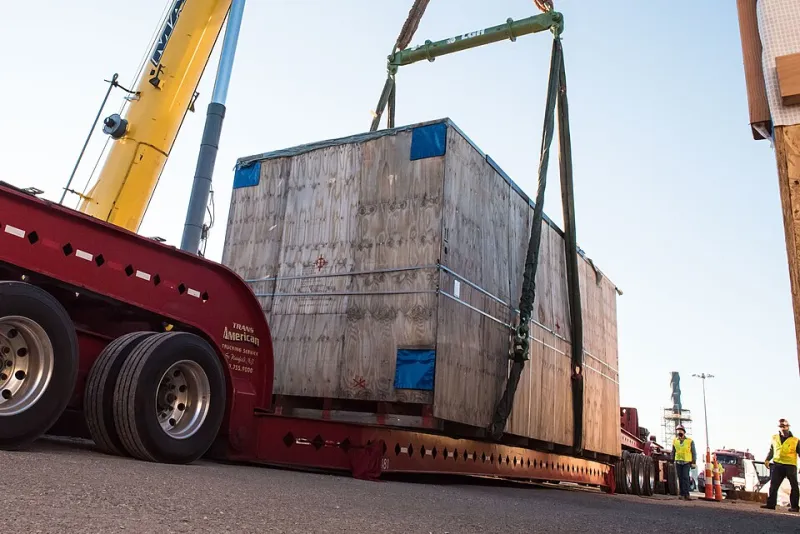
Photo: PEO ACWA, CC BY 2.0, via Wikimedia Commons
An oversize load begins as a set of dimensions and a delivery date. By the time it reaches the road, it has become a moving problem in three dimensions: height, width, and the patience of every community along the way. The driver at the wheel is only one part of the operation. Ahead of the truck, often by days or weeks, route surveyors and escort drivers are already doing the work that determines whether the load moves cleanly or becomes a cautionary tale.
The Permit Is Not the Route
A state permit office can approve a movement on paper. That approval does not mean the route is practical. Permit systems are built around known restrictions: bridge load ratings, overhead clearances, weight limits, and designated oversize corridors. They are not built to capture the temporary utility truck parked too close to a corner, the newly installed traffic signal that sits a few inches lower than the map suggests, or the intersection where a right turn requires swinging the trailer into a lane that is busy at 7:30 in the morning.
Route surveyors work in that gap between approval and reality. They drive the candidate route, sometimes in both directions, and record what the permit cannot. They measure turning radii. They note where a sign can be temporarily removed and where a utility line cannot. They check construction zones that may have appeared since the last survey. In 2026, routing software is more capable than ever, but the field still holds the details that decide a move.
The Math Before the Miles
Bridge formulas are the part of oversize transport that most people never see. A load that is legal by gross weight may still be too heavy for a specific span. A route that looks direct may require a detour of dozens of miles because one bridge cannot carry the combination. Surveyors gather axle weights, spacings, and dimensions, then work with state DOT offices and sometimes structural engineers to confirm what the load can legally cross.
The math does not end at bridges. Height poles, low-clearance maps, and utility coordination all feed the same decision. A load that is 16 feet tall may clear one route and fail another by a matter of inches. The difference is not academic. It is the difference between a scheduled night move and a shutdown of a main street while crews figure out how to back a trailer out of a situation that should never have been entered.
The Intersection That Doesn't Read the Plan
Small-town intersections are where route plans go to be tested. A wide load may need both lanes, a temporary closure, or a spotter positioned where the driver cannot see. Escort drivers often arrive ahead of the load to coordinate with local police, utility crews, and business owners. They check whether the corner can be taken without clipping a curb, a fire hydrant, or a parked car that no one expected.
The best escorts are not simply vehicles with flashing lights. They are field observers with a specific kind of judgment. They know when to hold traffic and when to wave it through. They know how a driver will read a hand signal at dusk. They know that a route which worked at noon may fail at rush hour because the turning space is now occupied by delivery trucks and pedestrians. The plan is a starting point. The field is where it becomes a sequence of decisions.
The Rolling Choreography
Once the move begins, the operation becomes choreography. A pilot car runs ahead to warn oncoming traffic and check clearances. A rear escort protects the load from drivers who misjudge its width. On superloads, police escorts and utility bucket trucks may join the procession. Communication is constant and usually unglamorous: radio checks, mirror checks, hand signals, and short confirmations that everyone sees the same hazard at the same moment.
The work is repetitive until it is not. Most miles pass without incident. Then a low branch appears, or a construction barrel narrows a lane, or a driver tries to pass a load that is already using more than one lane. The escort's job is to absorb those surprises before they reach the trailer. That requires more than a pilot car permit. It requires the ability to read a road as a system of clearances, speeds, and human behavior.
The Call to Stop
Not every route survives contact with the field. A surveyor may find that a bridge has been posted with a lower limit since the permit was issued. An escort may discover that a utility line has been lowered or that a road is blocked by an event no one flagged. The professional response is not to force the move. It is to stop, document, and call for a revised plan.
That call can be unpopular. Schedules are tight, cranes are waiting, and customers are counting hours. But the cost of a failed move is measured in more than delay. It can include damaged infrastructure, injured workers, and a community that loses confidence in the next permit request. The escort driver or surveyor who says stop is protecting the entire operation, even when the operation does not want to hear it.
The Last Mile Is a Profession
Oversize freight is often described in terms of dimensions and permits. The real work happens in the last mile of planning and the first mile of execution. It is done by people who spend their days measuring clearances, talking to local officials, and watching traffic patterns that no database captures. They are not the most visible part of the supply chain, but they are the part that keeps the visible part moving.
A wide load is a narrow margin business. The route that works is rarely the shortest one. It is the one that has been scouted, questioned, and confirmed by people who know that the map is only a proposal.